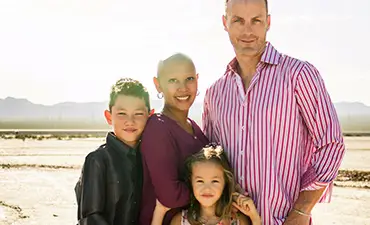
Dana Templeton
Bob Richardson is a little pushy with some of his friends, and he’s not going to apologize for it. “I will dog you to get a colonoscopy,” he says. “You don’t have time? Don’t think you have issues? Don’t like the idea of the procedure? Guys – You’re asleep. Get the colonoscopy.” He takes no excuses, and he doesn’t take “no” for an answer. For those that procrastinate, he threatens to show his scars to their wives, marks of battle earned through his personal journey with colon cancer. “I will drive you. I will make the appointment for you,” he tells them. “I just keep harping.”
A few years ago, Bob – who farms in Macon and works for the Norfolk Southern Railroad – was the one who didn’t have time for the colonoscopy. With no history of cancer in his family, he wasn’t overly concerned when he first began feeling ill in March 2012. At first, they thought it was food poisoning. When his symptoms didn’t go away, his doctor diagnosed him with a bacterial illness, then suggested he had Irritable Bowel Syndrome. It took nearly a year for Bob to receive the correct diagnosis – colon cancer. By that time, the cancer had spread to his liver.
In February 2013, doctors gave Bob two years to live. “All of it was totally overwhelming,” says Tammy, Bob’s wife of 40 years and high school sweetheart. She looks back with hindsight: “I wish we’d been more aggressive with the doctors before the diagnosis. Our regular doctor had recently retired, and we didn’t know where to go.”
When the general practitioner they visited didn’t immediately find anything of concern, they didn’t push for a colonoscopy, accepting at first the doctor’s suggestion that Bob’s trouble was a food-related issue. “He had (cancer) going in,” Tammy says. “But it might not have spread so much if it had been caught quicker.”
Bob received his colon cancer diagnosis on a Wednesday. On Thursday, they learned the cancer was also in his liver. On Friday, family pushed them to head to the Mayo Clinic without an appointment. “You put one foot in front of the other,” Tammy says about making it through the initial diagnosis. “We did what we had to do, and it was scary as hell.”
Every step seemed to bring more bad news. On Sunday, only four days after his diagnosis, Bob and Tammy showed up at Mayo, hoping for a cancellation. The next day, they got their wish, but the appointment brought more heartache instead of hope – the cancer ran deeper than they had originally thought, surfacing in spots on his lungs. Recommended treatment included surgery, but the thoracic surgeon, looking at the spots on his lungs – the size of grains of sand – refused.
Back in Missouri, at Missouri Cancer Associates, Bob immediately began an aggressive course of chemo so strong that, 10 minutes after the drugs were fighting the cancer in his body, all the color would drain from his face. His jaw would lock up, and he couldn’t talk.
By the time he was into his third chemo treatment, he had to push himself to keep going and endure the drug’s side effects. The two-year prognosis weighed heavily on him. He reminded himself he was doing it for his family. “(The chemo) was killing me,” he said.
Watching him struggle with the pain of the chemo and feelings of hopelessness, Tammy and his two kids, Lynette and Tim, pushed him to remember to fight. “This is not the end of everything,” Tammy would remind him.
Despite the encouragement of his family and his efforts to stay strong, depression set in. Dr. Joseph Muscato from MCA added an anti-depressant to his RX regimen. “It was the best thing we did,” Bob says, looking back about getting help for his depression.
In June 2013, hope arrived. Responding to the chemo, the spots on his lungs had disappeared. Dr. Muscato was a staunch advocate for Bob, insistent upon the surgery he needed, and Bob discontinued chemo for four months both to prepare for surgery and then to recover. “Dr. Muscato – this is the doctor you want,” Bob says about the ally he found.
In August, the surgeon removed 18 inches of Bob’s colon, 20 percent of his liver, and a portion of his diaphragm. In October 2014, a new scan revealed the spots on his lungs had returned. “It was a roller coaster,” Tammy says. “Big highs, and big lows.”
“Early on, you just have to lean on faith and hope for the best,” Bob says about facing a cancer diagnosis. He’s proof that you can’t give up. Today, four years after his initial diagnosis and prognosis of two years to live, Bob is a regular at MCA, arriving every two weeks for the maintenance chemo he will be on for the rest of his life.
“The people are all tremendous,” he says about his care and support team at MCA. “Dr. Muscato is open to talk to. He’ll answer any question, explore any option. You call with questions, and it’s no big deal.” The long-standing fight has created a secondary family for Bob, with friendships that go beyond basic health care professional and patient interaction. “You see wedding photos, baby photos,” Bob says. “Danielle adopted me when I came in – they all take great care of me,” he adds with a smile.
“I can’t even begin to compliment the whole place enough,” says Tammy. “From Dr. Muscato to the techs to the people who clean to the volunteers. Everyone is helpful and upbeat. You don’t want to be there, but the people make it bearable.”
“I like it where I am,” Bob says about choosing MCA. “But I pray for the day when they are all unemployed.”
Life looks a little differently than it did for him in 2013, and it’s not all because of the cancer. He’s now a grandpa, with three grandsons – Cannon, 1; Sam, 1½; and Bode, 2½. Each year, he buys a calf to raise and sell to build up their college funds. The boys like going for rides on the John Deere Gator – and their Dairy Queen trips for ice cream and fries – with Grandpa. “(Cancer) changes how you look at life,” he says. “I am a baby boomer. I was a workaholic, and it was an inconvenience to take time out, go on vacation. Now, if you want to go do something, I say, ‘Yeah – let’s go.’” He says he has become more forgiving and a better listener. Knowing how terrified he was at his first chemo treatment, he often seeks out newcomers at MCA to offer support. “I’ve had 101 treatments. I know the ropes.” he says
Through his journey, Bob says he’s also become more passionate about helping people. “If it will get somebody tested, it’s worth it,” Bob says about sharing his story with others. “There’s no tomorrow for me or for you. Only right now,” he says. “Life is good. Cancer sucks, but life is good. Without it, I wouldn’t have met all of these wonderful people.”
Colorectal cancer is the third most common cancer diagnosed in both men and women in the United States. Early detection makes the difference.
[post_title] => Bob Richardson [post_excerpt] => [post_status] => publish [comment_status] => open [ping_status] => open [post_password] => [post_name] => bob-richardson [to_ping] => [pinged] => [post_modified] => 2020-04-11 01:01:43 [post_modified_gmt] => 2020-04-11 01:01:43 [post_content_filtered] => [post_parent] => 0 [guid] => http://usoncology.com/patient-stories/bob-richardson/ [menu_order] => 0 [post_type] => msh_patient_story [post_mime_type] => [comment_count] => 0 [filter] => raw )At just 20 years old, Dana Templeton received a diagnosis that would change her life — and her perspective — forever. In early spring of 2011, Dana Templeton was a petite, attractive, full-of-life 20-year-old with no idea how her life was about to change. But in March, she felt a knot in her throat — a lump when she swallowed. Her lymph nodes became enlarged, becoming visible in her neck. Her doctor told her not worry, that her body was fighting infection. Nothing out of the ordinary. Dana went on with her life, working toward her education degree and as a preschool teacher at Little Learners Lodge in Jefferson City. She started dating 25-year-old Josh Wilson, a friend of her brother.
Life was good, but over the next few months, she watched and felt her lymph nodes became larger and harder. She consulted with an ear, nose and throat (ENT) specialist, and after an ultrasound and three biopsies, her ENT assured her that dying cells were the cause of her trouble. In December, she had surgery that she expected would fix everything, but on Dec. 6, she learned she had Hodgkin’s lymphoma. “I was looking forward to my 21st birthday, not having cancer,” she says. “I was 20 years old. I didn’t want to die. I didn’t want to be bald.”
It’s hard to think about mortality when your adult life is just beginning. Losing her hair became a tangible focal point for her worry. Less than a week after her diagnosis, Dana met with Dr. Joe Muscato at Missouri Cancer Associates. “I told them I didn’t want to lose my hair,” Dana says about meeting with Dr. Joe and the MCA staff, including social worker Denise Swenson. “Denise told me, ‘Your hair can come back, but if you die, you can’t.’”
Dana learned she had stage 3B cancer in both shoulders and her spleen. “I like to laugh, but my dark jokes weren’t very funny,” she says, thinking back to those first few days of trying to handle the news. “‘This is like my last supper,’ I said at Christmas.” She started chemo Dec. 29.
Dana took a semester off college to focus on treatment. Every other Thursday was chemo day. She would work half a day on Thursday and all day Friday before the effects of the chemo would hit her on Saturday, including exhaustion and pain in her jaw and mouth. Her skin took on a yellow tint, and she had no energy for anything. She sucked on sugar-free popsicles and ate raw spaghetti noodles when she didn’t have an appetite for anything. Through treatment, she drew primary support from her mother, Carla Templeton, and Josh.
“A lot of people say, ‘Good for you for sticking with her,’” Josh says about his relationship with Dana, only just beginning when she began her cancer fight. “But I never thought of leaving her. The hard part was hers.”
With a different set of hardships and an uncertain future facing them, Josh and Dana say they became a little more serious, more quickly, than their relationship might have progressed under different circumstances. “When I know I looked sick, he never treated me like someone with cancer,” Dana says. “He told me I was so pretty. When he knew I didn’t feel well, he would say that we could just lay down.”
Josh brought her a book with stories of cancer survivors from the library to try to keep her attitude positive, and he says he let Dana lead conversation. “When there’s nothing you can really do, it’s tough,” he admits. “You just have to be able to listen. She wanted someone to let her cry and complain and to not tell her everything was going to be OK — because it wasn’t OK.”
He knew that the things she might miss out on weighed heavily on her mind and that she worried if her mom was going to be OK. Dana acutely knew what loss meant: Her dad died in a car wreck when she was 12 years old. “When you have experienced the worst of things, you expect the worst,” Josh says.
Dana was fighting cancer at a time in her life when possibilities should have been opening for her, and she knew how her present was — and her future might be — very different from those of her friends.
“My friends were using their fake IDs while I was going through cancer,” Dana says. “But I didn’t want to be known for cancer.” When she needed reassurance, Josh was there, but they both say it was Robin Hubble, her nurse at MCA, whom she listened to.
“I might say something, but what Robin said was gold,” Josh jokes. “They are exactly alike — the same bluntness, stubbornness, witty, with the same humor.”
“I didn’t like Robin at first,” Dana says. “But she was exactly what I needed.” Robin was part of what Dana calls her “A-Team” at MCA, a support network that provided much more than physical care.
Through the weight of the chemo treatment and the physical and emotional toll of the path she was on, Dana worked to maintain some normalcy in her life. Every day, she went to work and smiled at the 4- and 5-year-olds in her class at Little Learners Lodge. Preparing for her hair to fall out, she told them she was sick and that her hair might go away. “They told me to ask to not get that cough medicine because it’s gross,” Dana says smiling.
She cut her hair shorter, into a pixie cut, and waited. On the day she ran her hands through her hair and looked down at the pieces falling out into her palms, she says it was like watching a movie. “Girls define themselves by their hair,” she says. “It was a tough pill to swallow. And I didn’t even think about losing the hair on my arms, my eyelashes.” Little wisps of hair lingered, covering her head. She wore a ball cap to work. Friends donated money to buy a wig, but she felt even more self-conscious the few times she wore it. “It was never really a part of me,” she says. It took a while for hair to be all gone. Cutting her hair shorter before it started falling out had been on her own terms, but Dana refused to shave her head. She didn’t want cancer calling the shots.
At MCA for treatment, she met a woman with beautiful, long, wavy blonde hair in the chemo room.
“She walked around like she still had a full head of hair, not like she had bald spots,” Dana says, revealing the sense of dignity and power she witnessed. “She kept curling what she had left.”
With the Hodgkin’s affecting her lymph nodes and in her blood system and the chemo wiping out her immune system, Dana was at high risk for infection during her treatment. She caught a cold, and antibiotics didn’t help. She called MCA to say she didn’t feel well, and when they called her in for an appointment, she says it took Dr. Joe all of eight seconds to tell her they were admitting her to the hospital. Normal white blood cell count is around 3,000. Dana’s was at 86. She spent three days in Boone Hospital, where they checked her vitals every hour. Physically, cancer was doing its worst, and looking back, she thinks she was sicker than she knew at the time. A sign on the door cautioned against visitors, and when staff at the hospital asked if she had accepted she might lose her battle, she says it was “unsettling.” Josh stayed by her side. “It felt like forever,” Dana says about the hospital stay.
Her body was weak. Dr. Joe advised her to take a break and not start her next course of chemo, to let her body rest, but Dana was determined. She only had three treatments left, and May 31 was marked on her calendar as the last chemo day. “I didn’t want to go one day past what was planned,” she says.
They wheeled her to the treatment room from her hospital room, and on May 31, she met her deadline. One month later, Dana waited, filled with anxiety, at MCA to find out if her course of treatment had done its job. She watched the faces of Dr. Joe and the scan tech for any indication of the results. “They showed me a scan lit up in the shoulders, spleen and neck, and I thought I had done it all for nothing,” Dana says. “But it was the first scan (from before the chemo). The second scan was clear. It didn’t hit me until on the way home — it was over.”
The next few months were a difficult transition as Dana struggled with fears that wouldn’t go away. “Cancer-free … I thought that life would go back to the way it was before, but that was not the case,” she says. “I thought everything was going to make me sick again.”
She remembers the day that summer when she slowly drove from Jefferson City to MCA for an appointment. By the time she checked in at MCA and was escorted to a treatment room, she was convinced she was going to hear devastating news. “I heard whispering outside the door, and I thought they were talking about me,” Dana says. “When Dr. Joe came in, I said: ‘Just tell me. I probably have a brain tumor.’”
Her team at MCA stepped up again to support her. Dr. Joe and Robin assured her that she was fine. Later, when Denise from MCA called to check on her and said that they were worried about her, Dana says she lost it. “I started crying,” she says. “I was terrified of everything, of the house burning down, that I would get robbed.” Fear was ruling her life.
Her support team at MCA helped her realize that the life she had before she was sick wasn’t the life she had anymore. She had to accept the new normal and switch off the survival mode she had been in during treatment. Dana started wearing a rubber band around her wrist. Every time anxiety threatened to overtake her, she snapped it to remind herself it was going to be OK. Slowly, she began to heal emotionally.
As time went on, Dana found herself adjusting to her new normal. She and Josh moved in together and enjoyed the blessings of day-to-day life without the cloud of cancer. She recalls the day of the second anniversary of her diagnosis — Dec. 6, 2013. She had an appointment at MCA, and she and Josh got into an argument the night before. “Let me know how the appointment goes — maybe I will meet you for lunch afterward,” Josh told her before she left. Still irritated from their disagreement, Dana says she ignored him.
At MCA, she and her mother waited together in the exam room for Dr. Joe. Her mother played with her phone, asking Dana how the video function worked. Dr. Joe came in, but then said he had to leave to check on another patient. When the door opened again, Dana’s view of the day — and Josh — changed. Josh’s mother walked in with Josh and Dana’s dog, Gracie, and a camera — “like the paparazzi,” Dana says. Josh was right behind her. He dropped down on one knee and proposed, with their mothers capturing the scene on camera and her MCA team watching.
A few days before, Robin had suffered the loss of her brother. “She was off work, but she came back to be here the day he proposed — to be here for that moment,” Dana says. “That meant a lot.” Josh changed a negative — the anniversary of her diagnosis — into something positive, Dana says. The moment was an apex, bringing together the struggles and pain of the past year; the support from her family, Josh and her MCA team; and hope for the future.
They celebrated their engagement with cake in the chemo room, with family and friends that a younger Dana never would have dreamed would be part of her life’s love story.
Josh and Dana were married on June 27, 2015, with honorary guests Dr. Joe and his wife, Mary, in attendance. On June 28, Dana celebrated her third anniversary of being cancer-free. Josh and Dana’s son, Graeme, was born in August 2016, and Dana is in her second year of teaching third grade at South Elementary in Jefferson City, where she’s enjoying her roles as a new mom and teacher.
For both Josh and Dana, Dana’s cancer fight left them with a new perspective on life. Although no one would choose the battle, when it’s over, the new outlook is a gift not to be returned. “Anybody who is a survivor says they enjoy the perspective that (cancer) gave them,” Josh says. “You wouldn’t erase that chapter.”